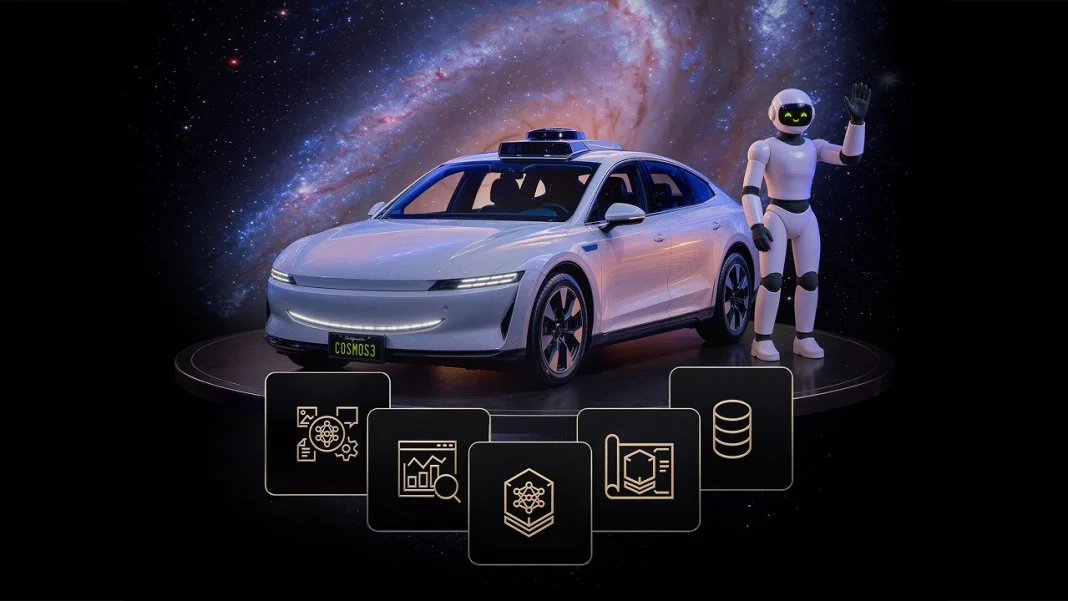

Company NVIDIA introduces revolutionary AI model Cosmos 3 for autonomous systems
Company NVIDIA has introduced Cosmos 3 — the first completely open AI model for physical systems that can significantly speed up the learning process of artificial intelligence.
Cosmos 3 is considered the world’s first omnimodel, capable of processing and generating various types of data using visual “thinking”. The model’s architecture combines two types of transformers: for logical analysis and result generation. The model works with text, images, video, sound, and actions using a large set of multimodal data.
One of the key advantages of Cosmos 3 is the significant reduction of training time for physical AI systems from several months to a few days, which can be a significant step forward in the development of robot and autonomous transport technologies. Developers can use this model for various tasks such as visual information analysis and environment simulation.
Together with the new model, NVIDIA announced the creation of the NVIDIA Cosmos Coalition, which includes companies striving to develop open models for physical AI. This should help accelerate the industry development and increase compatibility between different platforms. The coalition’s goal is to exchange research and system evaluation methodologies.
Cosmos 3 is already available for developers in two versions: Super and Nano. A simplified real-time version, Cosmos 3 Edge, will be released later. The model can be tested on the NVIDIA platform, and open models are available through Hugging Face. The company also provided tools for model customization and synthetic data generation.
| Key Features | Cosmos 3 |
|---|---|
| Data Processing | Text, images, video, sound, actions |
| Types of Transformers | For logical analysis and result generation |
| Model Variants | Super, Nano, Edge (later) |
| Collaboration | NVIDIA Cosmos Coalition |