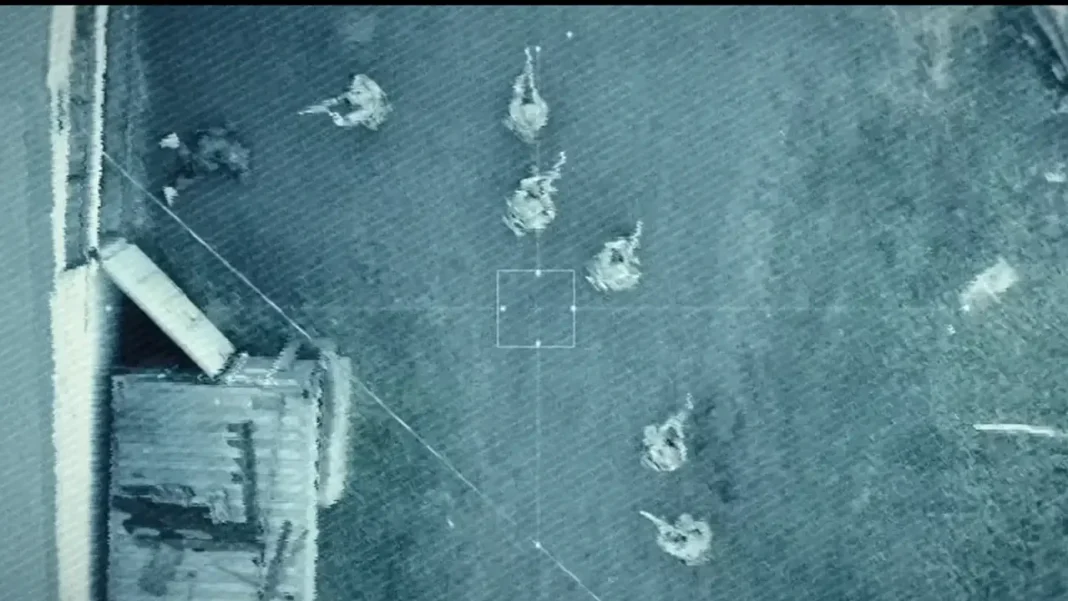

The Ukrainian military action “Killhouse” directed by Lyubomyr Levytsky opened a new chapter in Ukrainian cinema. As the first Ukrainian film created with the participation of real SBU fighters and the Ministry of Defense, the film sparked a wave of discussions about the possibilities of drone technologies in modern warfare.
The film “Killhouse” tries to depict real combat conditions, where reconnaissance is carried out using quadcopters such as DJI Mavic and SHARK-D unmanned systems. Cameras mounted on the drones help viewers feel the heart of the battle from the inside. The film also showcases “Strizh” drones capable of uniting into groups for mass target destruction. Such a concept provokes numerous discussions about the technological feasibility of such systems.
Experts from Buntar Aerospace note that modern military drones are already capable of identifying and hitting targets using machine learning and autonomous targeting. However, the creation of computer systems that could operate completely independently remains challenged due to problems with coordination algorithms and limited computational power. An important task also remains to ensure reliable communication in the conditions of fighting with radio-electronic interference.
Experts emphasize that the implementation of the swarm drone concept in real combat conditions is still a challenging task. The autonomous navigation and flight coordination capabilities in today’s implementations are limited, and such systems require serious engineering refinements and financial investments.
Concerning the ability to recognize faces and “live/dead” detection, technologies already exist that can recognize human faces and determine movement. However, under conditions of uncertainty and the presence of various natural and technical obstacles, their effectiveness can be significantly reduced, making them not so reliable in battles.
Indeed, drone warfare is becoming a competition not of individual devices but of entire complexes of technologies and data exchange networks. Ukrainian developers have certain advantages due to the speed of technology adaptation, and interaction with international partners opens access to advanced developments. However, the enemy is also actively developing its capabilities, particularly the use of machine learning technologies and network exchange, which poses new challenges for Ukrainian engineers.
| Technology | Technological Status | Challenges |
| Autonomous drone navigation | Development | Communication protection, computational power |
| Kinetic impact with drones | Theoretically possible | Energy efficiency, mass |
| Face recognition and “live/dead” | Development | Reliability in combat conditions |
| Drone swarms | Experimental phase | Coordination, protection against electronic warfare |