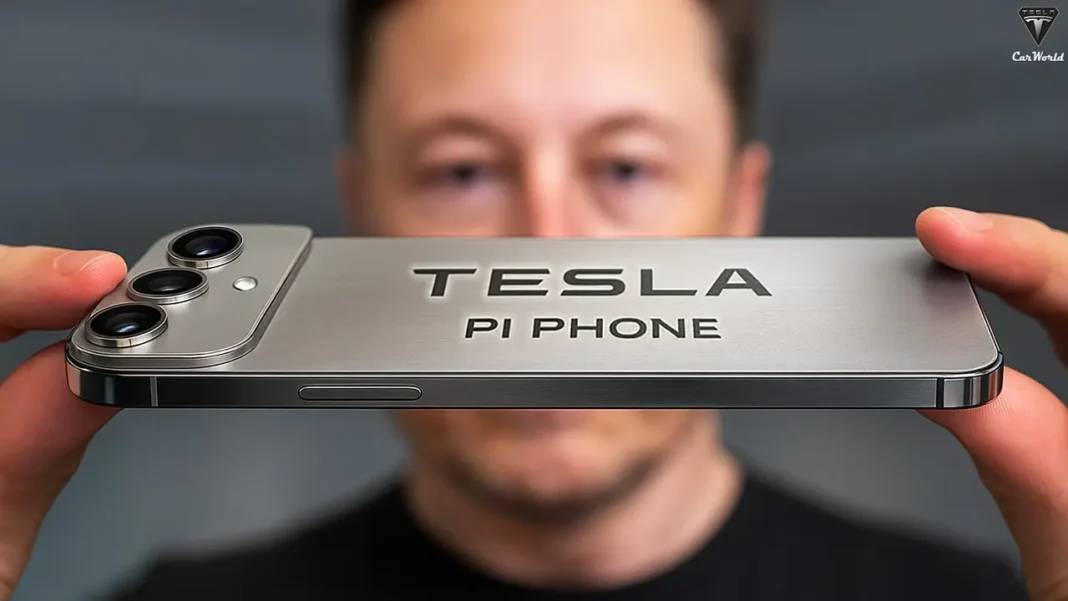

Why the world is waiting for a “phone from Elon Musk”
For several years now the internet has been periodically exploding with news about a “revolutionary Tesla Model Pi smartphone” that is supposedly about to change the market, destroy Apple’s position and free us from mobile operators. On TikTok, YouTube and Facebook dozens of videos appear with “presentations”, while little-known websites publish “reviews” and “specs” for a device that does not yet exist.
Against this background a logical question arises: is the Tesla Pi smartphone a real project by Tesla, or just a beautiful digital myth fuelled by clickbait and artificial intelligence?
The official position of Tesla and Elon Musk: there is no smartphone
As of late 2025 Tesla has never announced a smartphone — neither at presentations, nor in official press releases, nor in investor documents. Leading media and fact-checkers directly state: the company has not declared any development or launch of a Tesla Phone or Model Pi.
In October 2024, during a public event in Pennsylvania, Elon Musk was asked when Tesla would release its own smartphone. His answer was quite revealing: he said he “really hopes the company won’t have to make a phone” and even added that the very idea of getting into smartphones “makes him want to die”. According to him, only if Apple or Google someday block Tesla or X apps in their ecosystems would there be a need to consider an alternative in the form of a proprietary phone — but for now there is no such necessity.
Fact-checking organisations in 2024–2025 repeatedly examined viral posts about the “launch of the Tesla Phone” and each time came to the same conclusion: neither Tesla nor Musk have announced a smartphone, and all these “news stories” are based on speculation, fan-made concepts or outright fakes.
Where the legend of Tesla Pi came from
The first waves of hype around Tesla Pi appeared back in 2021–2022, when designer-fans of the brand published impressive 3D renders of the “perfect Tesla smartphone”, and YouTube channels launched videos with loud headlines about the “end of the iPhone era”. At the same time, no major international media reported on any real product, and the story existed mainly in blogs and on second-tier websites.
Over time, a whole ecosystem of specialised pages and websites emerged — something like “tesla phone 2025” — that collect traffic thanks to search queries like “Tesla Pi phone”, “Tesla Model Pi price”, “Tesla phone release date”. Some of them honestly admit that all the specs are nothing more than rumours and fantasies, but the headlines and page design create the impression that this is an official project.
What viral “Tesla Phone announcements” promise
If you look at popular videos and posts about Tesla Pi, you can build a typical “portrait” of this mythical smartphone. It is given an impressive range of features that perfectly match what Musk’s fans dream of:
- direct connection to Starlink satellite internet without a SIM card and without coverage from mobile operators;
- solar panels on the body, supposedly allowing the phone to charge without a wall socket;
- integration with Neuralink and “mind control”, including the ability to reply to messages using thought alone;
- deep integration with Tesla electric cars: controlling the car, summon from parking, remote climate control and so on;
- operation on Mars, a special “Mars Mode” and “optimisation for colonising the Red Planet”;
- a price tag of 237, 295 or 789 dollars (the amount depends on the particular fake video), which looks suspiciously “nice” for such a set of capabilities.
Fact-checkers analysing such videos and posts emphasise that none of these characteristics is confirmed by any official source, and that the “announcements” rely on edited footage, fan renders and fabricated quotes.
Autumn 2025: a new wave of fakes and the “mind-control phone”
In autumn 2025 the myth of the Tesla Phone received new life when a video went viral on social networks in which Musk supposedly presents a “thought-reading phone” with Neuralink and Starlink support. The video promises free internet, “telepathic communication” and a market-ready “Tesla Pi Phone”.
Several independent fact-checking platforms analysed this video and reached the same conclusion. Experts found signs of AI generation: artificially overlaid face, synthesised voice, reused fragments of old CGI clips about the “Tesla Phone”, absence of mentions in major media and a complete lack of reference to the product on Tesla’s official resources. The bottom line is simple: the video is fake, there is no Tesla smartphone on the market, and a consumer “mind-controlling phone” with Neuralink does not exist.
The half-truth on which the legend rests
The strength of the Tesla Pi myth lies in how skilfully it mixes fantasy with half-truth — that is, with real technologies that do exist, but in a different form.
1. Controlling a Tesla car via a smartphone. Today Tesla owners really can control their cars from a smartphone: start climate control, unlock doors, monitor the battery charge, summon the vehicle from a parking space, and more. This is done via the official Tesla app for iOS and Android, not some “special phone”. In other words, one of the key “features” of the mythical Tesla Phone is simply functionality that ordinary smartphones already have through an app.
2. Starlink as a source of internet. Starlink satellite internet is a very real service from SpaceX. But it works via dedicated terminals and antennas, not through a “magic module inside a Tesla smartphone”. As of late 2025 there is no confirmed project of a smartphone with a built-in Starlink antenna, and certainly no mention of Tesla Pi in any official documents.
3. Neuralink and “the end of the smartphone era”. Neuralink is a real neurotechnology company founded by Musk that is developing implants to read brain activity. Its first clinical trials are focused on helping people with paralysis, speech problems or vision loss, not on creating a mass-market “telepathic smartphone” for everyone.
Musk himself has repeatedly said in 2025 that he sees the future not in new smartphones but in “brain-computer” interfaces, which could eventually make phones unnecessary. However, this is a distant prospect, and mass-market products are still years or even decades away.
Why the Tesla Pi myth is so persistent
The Tesla smartphone story is a great example of how technological myths are born and live in the digital age. Experts note that the wave of interest in Tesla Pi worked extremely well in search engines: thanks to the right keywords, clickbait titles and viral videos, content about a non-existent phone consistently gets millions of views and high positions in Google.
For some creators this is simply a cheap traffic-generation and ad-monetisation strategy. For others it is a way to funnel the audience towards selling “courses”, dubious investments or even fraudulent “pre-orders” for a non-existent device. Against this backdrop, users who see dozens of videos and articles easily start believing that “so many people can’t be wrong”.
Add to this Musk’s charisma, the popularity of the Tesla brand and a general fatigue with “ordinary” smartphones, and you have the perfect environment for yet another tech legend to be born.
How not to fall for fakes and fraudulent “pre-orders”
The Tesla Pi myth is not just a funny story about fans’ fantasies, but also a real risk for users who may lose money by believing in fake “pre-order pages”. Here are a few simple digital-hygiene rules:
- Always check whether the news is published on Tesla’s official website or in its investor section, as well as in major media outlets (Reuters, Bloomberg, BBC, leading tech publications). If only obscure websites or video bloggers write about a “revolutionary product”, that is a red flag.
- Be sceptical of videos that feature overly “magical” capabilities without links to primary sources — especially if they are screen-captured slides, edited voiceovers and CGI-animated presentation scenes.
- Do not send money for “reservations”, “early access” or “exclusive pre-order codes” if the page does not belong to an official company and the domain looks suspicious.
- Pay attention to fact-checking projects: many fakes about the Tesla Phone have already been thoroughly debunked and flagged as false.
Could a Tesla smartphone appear in the future?
The honest answer is this: theoretically yes, practically as of December 2025 there are no real signs of that happening.
On the one hand, Musk does not rule out that Tesla or a related company could someday enter the smartphone market if major platforms begin restricting access to his services. He has mentioned this more than once in the context of potential conflicts with Apple and Google.
On the other hand, today Musk’s and Tesla’s focus is much broader than smartphones: electric vehicles and autonomous driving, energy solutions, robotics (Tesla Optimus), artificial intelligence and those same Neuralink brain-computer interfaces. In his public appearances Musk talks more about how to get rid of smartphones thanks to new interfaces than about how to build yet another flagship phone.
Conclusion: Tesla Pi as a mirror of our faith in technology
The Tesla Pi smartphone story is a revealing mirror of the era we live in. On the one hand, millions of people genuinely want to believe in a “magic” gadget that will provide free internet, self-sufficiency and almost superhuman capabilities. On the other hand, reality is much more down-to-earth: the day-to-day evolution of ordinary smartphones, the slow development of satellite networks and the very cautious progress of neurotechnology from lab to clinic.
As of December 2025 the Tesla Pi smartphone remains a myth, not a product. But this story is useful because it teaches us to think critically, distinguish dreams from marketing and not confuse flashy AI-generated videos with real-world solutions we are ready to pay our own money for.
And if Tesla really does decide to enter the smartphone market someday, we will hear about it not only from TikTok videos, but also from official press releases, major global media outlets and stock exchanges.