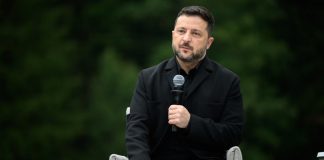
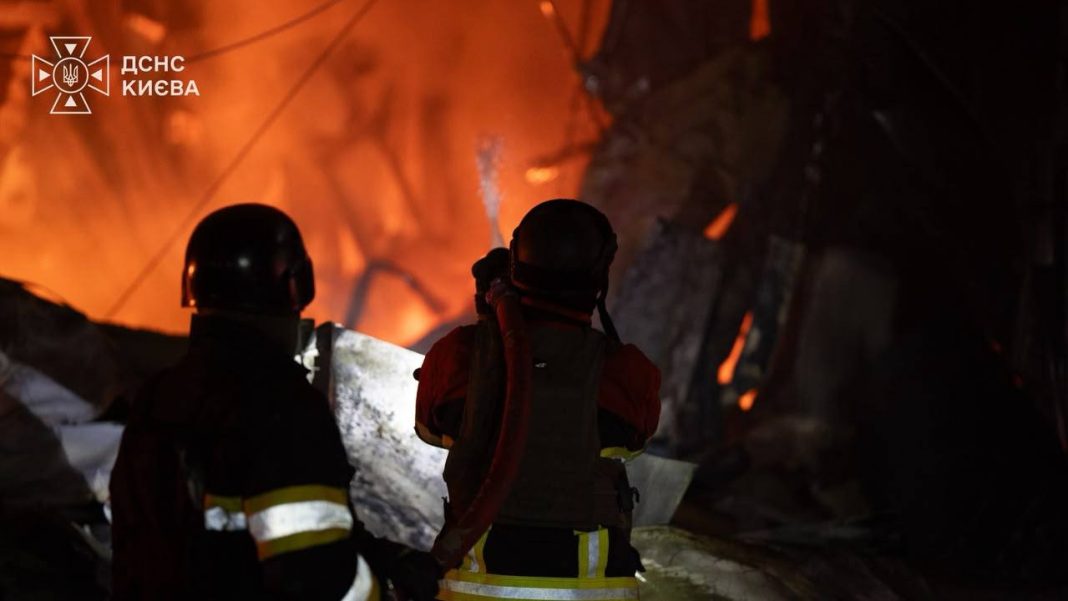

President Volodymyr Zelenskyy said that Russia carried out a “demonstrative strike” against Ukraine virtually immediately after another round of talks. According to him, 12 regions came under attack, with two people killed in Kyiv and other regions and another 34 injured.
Zelenskyy said that Russia launched 21 missiles at Kyiv in three waves of ballistic strikes. He noted that the city suffered a significant number of hits and damage.
“Since the evening, Russian ‘humanitarians’ have launched three waves of ballistic strikes against Kyiv. They used 21 missiles. Unfortunately, there have been a significant number of hits and damage in the city: ordinary residential buildings, energy facilities, the infrastructure of one of the railway stations and the metro, shopping centres, and businesses. One of the damaged sites was even a monastery.”
Volodymyr Zelenskyy, President of Ukraine
According to the head of state, five children were among the 34 people injured in Kyiv and other regions.
Call for increased pressure on Russia
The president stressed that the attack occurred virtually immediately after another round of talks and, in his view, demonstrated that there had been no real change in Moscow’s attitude towards the war.
“This means there have been no real changes in its attitude towards everything that is happening. It is important to continue trying to find the right solutions to end this war. But when Russian ballistic missiles are the response to negotiations, real pressure on Russia is needed to ensure different steps are taken — steps to stop the killings.”
Volodymyr Zelenskyy, President of Ukraine
Zelenskyy said there was a need to strengthen air defence, accelerate missile deliveries, enable the destruction of Russian ballistic missile launchers, and tighten sanctions.
Foreign Minister Andrii Sybiha, commenting on the attack, also sarcastically referred to Russian “humanism.”
“Tonight, Kyiv residents heard what Russian ‘humanism’ really sounds like.”
Andrii Sybiha, Minister of Foreign Affairs of Ukraine
He noted that appeasement, a willingness to please, and flattery would not stop Russia’s war, and that only strength could bring peace.
Context of the “humanism” remarks
Zelenskyy and Sybiha did not directly name any specific individuals. However, the day before, on October 21, US presidential special envoy Steve Witkoff held talks with Vladimir Putin in St. Petersburg. During the meeting, Witkoff called Putin a “humanist” in the context of the release of 74-year-old American Stephen Hubbard, who was convicted in Russia on charges of participating in Ukraine’s territorial defence.
The original report states that Russian occupiers abducted Hubbard in Izium in 2022. US Vice President J.D. Vance, commenting on the situation, said he considered the American’s release more important than the wording Witkoff used in reference to Putin.
US President Donald Trump, for his part, said that Putin could be called a “humanist” in order to secure the release of a person who thought he would spend the rest of his life in prison. At the same time, he said he would not comment “one way or the other,” recalling negotiations with Russia on ending the war.
On October 20, Ukraine, the United States and European partners held talks in Norway, and the following day Witkoff met with Putin in Russia. After that, the resumption of talks between Kyiv, Moscow and Washington at the delegation level was announced; such talks had not taken place since winter.
According to Zelenskyy, the agenda of the new talks will include ending the war, bringing peace closer, and preparing a meeting involving himself, Putin and Trump.