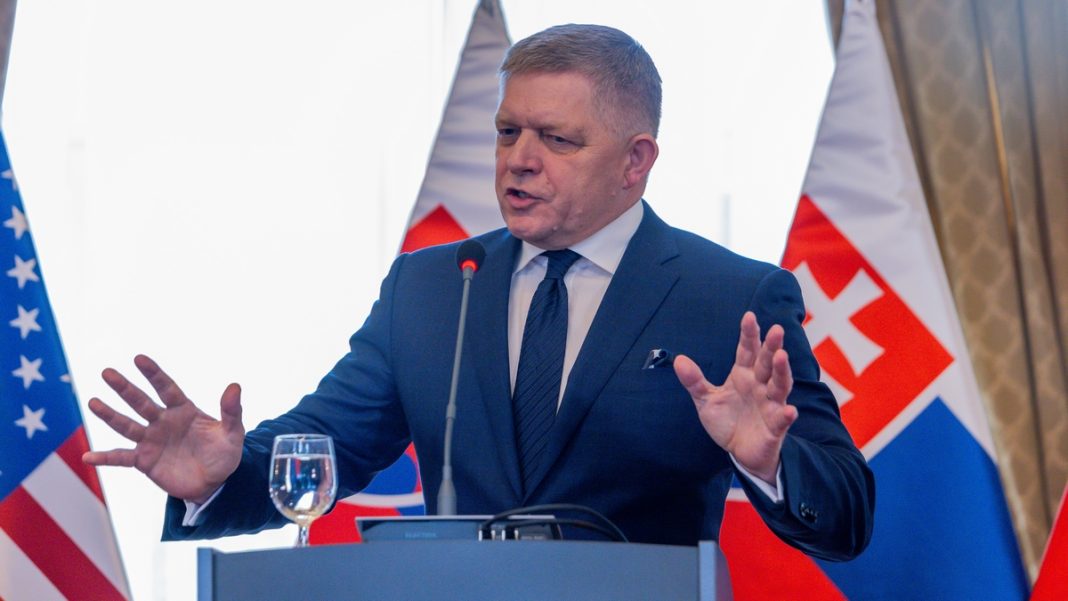

Slovak Prime Minister Robert Fico said he does not want Slovak troops to be involved in combat operations in a hypothetical scenario involving the invocation of NATO Article 5. He also announced a visit to Kyiv on September 18 for talks with President Volodymyr Zelenskyy and Prime Minister Serhii Koretskyi.
Fico made the remarks during a meeting with students and healthcare workers in Prešov. He spoke about the threat of war in Europe but did not name Russia as the aggressor or the source of the military threat.
“I do not want Slovakia to become part of any military conflict because of some Article 5. As prime minister, I will do everything to ensure that Slovakia is never drawn into a military conflict.”
Robert Fico, Prime Minister of Slovakia
Criticism of “bellicose rhetoric”
The Slovak prime minister criticized European politicians for their “bellicose rhetoric.” In his view, such talk is used to mask their inability to address problems such as illegal migration, competitiveness and high energy prices.
“Sometimes there is a tendency to replace the inability to solve problems such as illegal migration, competitiveness and high energy prices with these bellicose talks: come on, let’s fight. Who do we want to fight? Who?”
Robert Fico, Prime Minister of Slovakia
Fico also said he could not imagine a situation in which Slovakia might be required to deploy thousands of troops to take part in combat operations.
“Can you imagine, ladies and gentlemen, that Article 5 of the NATO treaty would be invoked? Can anyone imagine that? Can anyone imagine being told: prepare 5,000 soldiers, 10,000 soldiers, and they will go somewhere to fight? And we would not even know against whom, why, or for what.”
Robert Fico, Prime Minister of Slovakia
Article 5 of the North Atlantic Treaty enshrines the Alliance’s principle of collective defence: an armed attack against one or more NATO members is considered an attack against all allies. At the same time, member states determine the specific forms of assistance themselves, meaning this provision does not require every Alliance country to automatically deploy troops.
Western politicians have been discussing Europe’s and NATO’s readiness to counter the threat of invasion more actively amid an increase in Russian provocations and sabotage, including those involving drones.
Planned talks in Kyiv
Fico said he would arrive in Kyiv on September 18, where he would hold talks with Zelenskyy and Koretskyi. According to him, the heads of government of other European countries will also come to Ukraine.
In early June, during a meeting of the foreign ministers of Ukraine and Slovakia, Kyiv offered Bratislava cooperation in the field of defence. In mid-June, Fico and Zelenskyy discussed humanitarian aid to Ukraine, cooperation in the energy sector and the development of border infrastructure.
Jakub Janda, director of the European Values Center for Security Policy think tank in Prague, told LIGA.net in August that he considers Fico’s government the most pro-Russian in Europe.