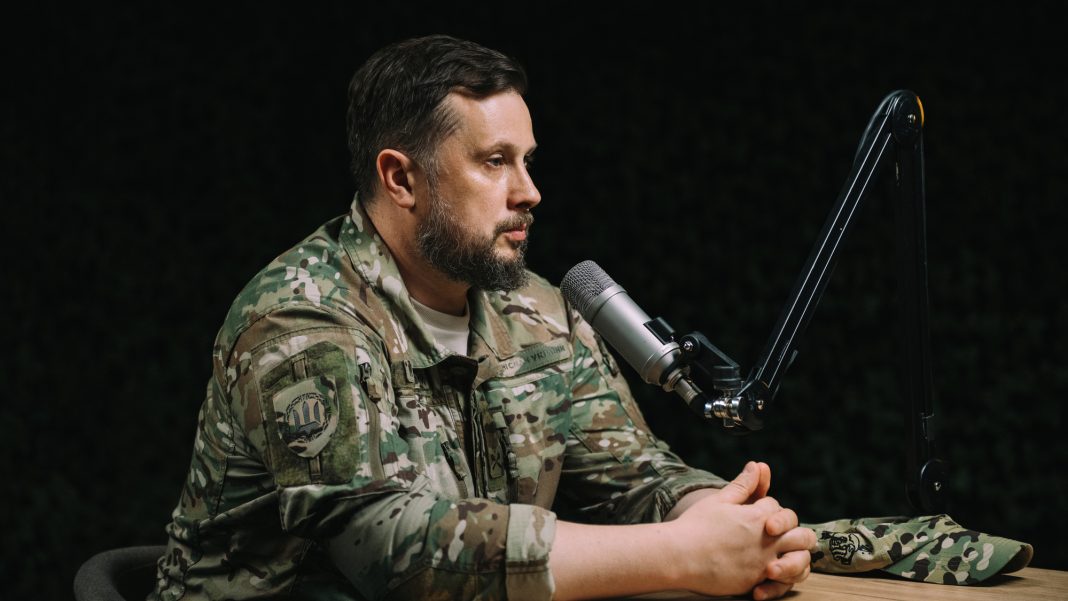

Operation Vivaldi in Donbas is intended to bring Ukrainian troops to advantageous defensive positions, said Brigadier General Andriy Biletskyi, commander of the Third Army Corps. He described the defence of the Donetsk and Luhansk regions as the strategic objective, rather than holding territory simply to control kilometres.
Biletskyi said this during the national telethon broadcast, responding to a question about the operation’s primary goal — reclaiming territory or disrupting the Russian offensive.
“Our main strategic task for the Armed Forces is defence in the Donetsk and Luhansk directions, the defence of the Donetsk and Luhansk regions. We are not fighting simply for the sake of tens or hundreds, or at some point even thousands of kilometres. First and foremost, we are fighting for advantageous defensive positions.”
Andriy Biletskyi, commander of the Third Army Corps, Brigadier General
According to him, the operation is intended to bring Ukrainian troops precisely to such positions.
Russia’s plan to encircle cities
Biletskyi said that the Russian forces’ plan in the Donetsk region was to encircle fortress cities from the north and south. From the south, the Russians planned to advance through Dobropillia, while from the north, they intended to move through a salient that, according to the general, is now being cut off.
“And it was moving toward the city of Sviatohirsk, and then further toward the settlement of Barvinkove, where these two pincers of the Russian army — the Dobropillia one from the south and the one from Sviatohirsk from the north — were supposed to close.”
Andriy Biletskyi, commander of the Third Army Corps, Brigadier General
The infiltration of Russian forces near Dobropillia was stopped last year, and the situation there is now difficult but under control, Biletskyi said. He described the northern “pincer” as effectively defeated and destroyed.
The commander stressed the importance of strikes on Russian logistics to prevent the offensive from resuming. If Russian forces fail to encircle the cities, they will have to assault the urban agglomerations of the Donetsk region head-on, which, in Biletskyi’s assessment, would be far more painful for them.
Russian forces continue offensive operations, seeking to seize the remaining territories of the Donetsk and Luhansk regions and establish full control over Donbas.
Infantry shortage and possible mobilisation
Biletskyi also commented on the Russian forces’ infantry situation and the possibility of mobilisation after the so-called elections in Russia. According to him, the Russians are “definitely better off than us” when it comes to infantry, but they have nevertheless faced a manpower shortage throughout the year.
The brigadier general believes that mobilisation is unlikely to radically change the situation for Russia, as an increase in the number of infantry troops would also mean greater losses.
“What decides everything now is the organisation of the reconnaissance-fire system. That is, there will be more infantry among the Russians — more 200s. But, undoubtedly, mobilisation will bring certain complications.”
Andriy Biletskyi, commander of the Third Army Corps, Brigadier General
According to him, those mobilised are not contract soldiers, and their deaths may lead to social tensions in Russia.
“Therefore, if we hold out, I think Russian mobilisation may be positive for us. The processes of Russia’s internal collapse will happen sooner; some aspects of them are obviously already present now, but they are still insufficient.”
Andriy Biletskyi, commander of the Third Army Corps, Brigadier General
On September 15, Biletskyi announced the launch of Operation Vivaldi, an offensive operation in the Donetsk direction. As part of the operation, the Armed Forces of Ukraine established full control over Novoselivka, Oleksandrivka and Yarova, took control of the outskirts of the settlement of Korovii Yar, and also liberated the village of Serednie.